
First published in Wood Culture: The Journal of Woodland Heritage, 2024.
Wood Culture: the Journal of Woodland Heritage is published annually as a benefit of membership. You can support Woodland Heritage by becoming a member — join below.
Once you’ve read the blog, discover the art of wood culture with an exclusive workshop tour and talk on the 19th June 2026 as part of Open Woods & Workshops. Tickets are £10 each. All proceeds from ticket sales will go to Woodland Heritage and you will hear from:
Tony Kirkham MBE VMH, former Head of Arboretum, Gardens & Horticulture Services at Royal Botanic Gardens, Kew
Simon Burvill, Founder and CEO of Gaze Burvill and also a Trustee of Woodland Heritage
John Orchard, Chief Executive of Woodland Heritage
John Deakin, Head of Trees and Woodlands – National Trust
By Simon Burvill, Trustee and Co-Founder Gaze Burvill
When Christian Gaze and I started Gaze Burvill 31 years ago, we had a vision of creating a beautiful collection of outdoor furniture using entirely oak grown in the UK. I was inspired by my one-year course at John Makepeace’s Hooke Park in Dorset where I had learnt about the necessity of adding value to British-grown woods to feed a virtuous cycle of growing and improving our woodlands.
It did not take us long to realise that to achieve this vision was going to be beyond our capabilities for two reasons:
1. Our designs featured flowing flared curves and the timber quality requirement to do this complex steam bending (straight-grained oak with no knots - identical to the requirements for barrel making) meant that it was practically impossible to find regular supplies of sufficient quality.
2. When we did find good clean oak for our steam-bent components, it did not ‘sit well’ alongside the more abundant knotty ‘character’ oak which formed the bulk of British oak.
We were advised that the only place we would find the right quality of oak was France – it would reliably meet our quality requirements, and even be cheaper.
Sustainability and having a low impact on our environment have always been key drivers for me, so I took time to do thorough environmental due diligence. In pre-internet 1994 finding French oak forestry sustainability information was difficult – there were no certification bodies: FSC was founded in 1993 but it was a long way off having any impact, and PEFC was set up in 1999, so it was all word of mouth from those in the know. Chris Sadd, softly spoken head forester of Hooke Park, described the Forêt de Tronçais, planted by Louis XIV’s minister Jean-Baptiste Colbert in 1670, as like ‘walking into a cathedral’ with magnificent columnar trunks, 20 m apart rising 30 m up from the forest floor without a branch, and going a further 10 m above that with their magnificent canopies.
As I learnt more, I also had to adjust my time perspective. Working with oak, everything takes time. The trees we use from France are generally 120 to 150 years old and there is a section of the Tronçais forest that is famous for being the only forest in France where the oaks are being grown and harvested on a cycle of 200 years plus!
I also found out that the UK had less than 12% forest area while France had over 30% and, being over double the area of the UK, had five times more forest for the same population of people, with a great deal of it being oak.
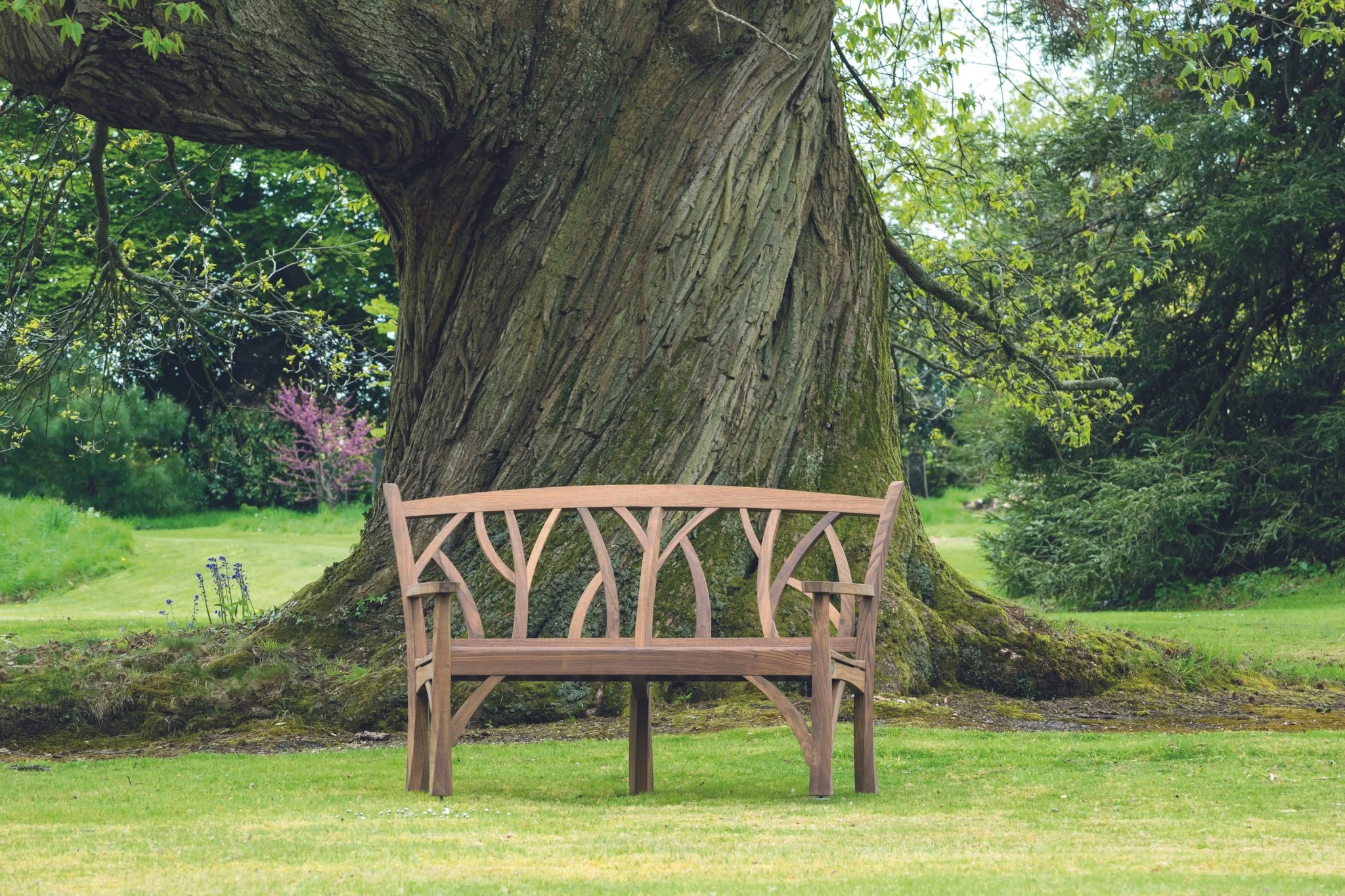
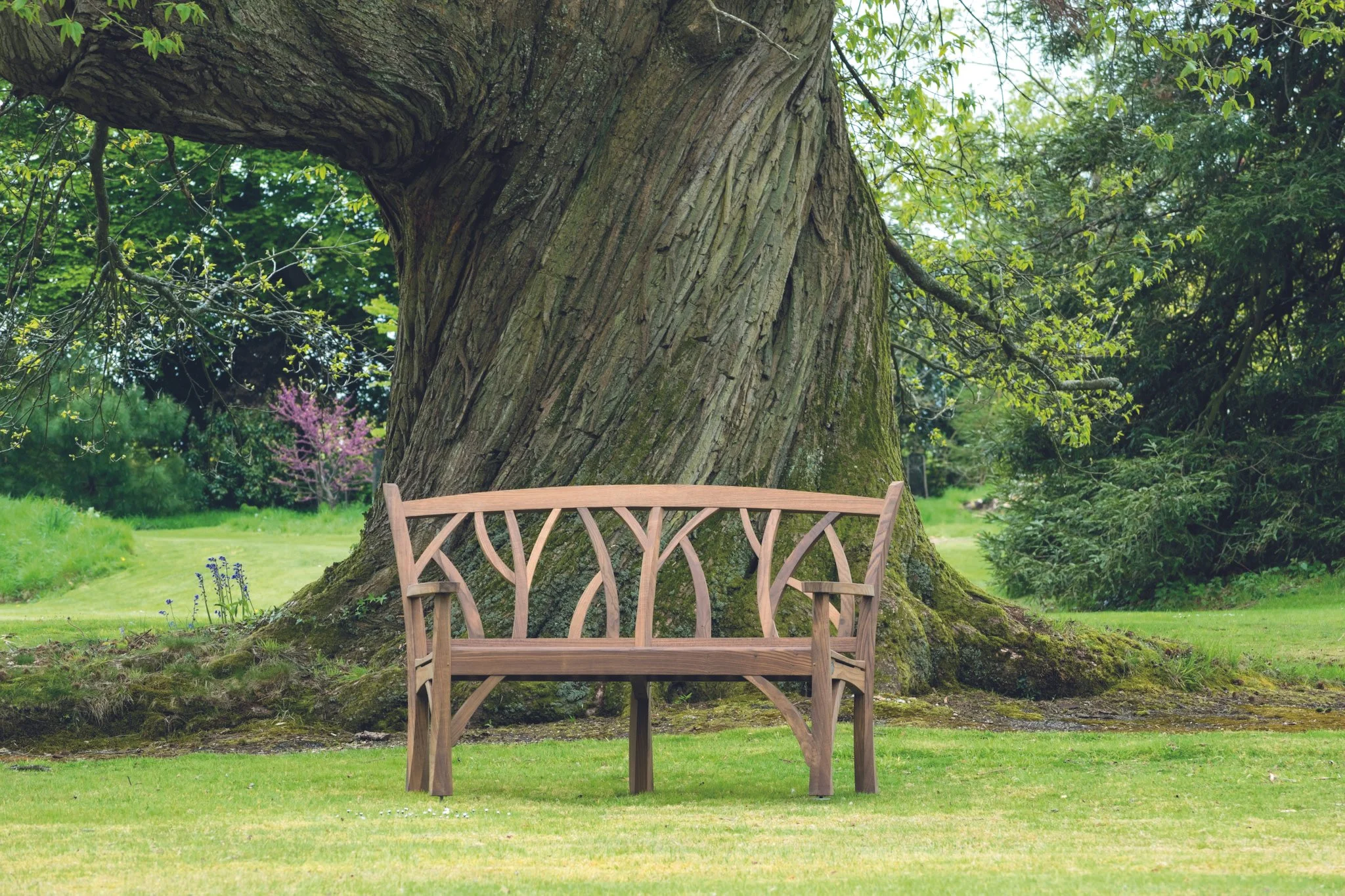
English sweet chestnut ‘Woodland Seat’ in front of large twisting sweet chestnut tree
And so, we became founder members of Woodland Heritage in 1994, hoping one day to source our oak from the UK, but for the time being, we would source our oak from France.
Nowadays the internet provides data on the starkly different scale of oak silviculture between France and the UK. France is Europe’s leading producer of oak. More widespread than all other species of hardwood in France, oak accounts for 5.53 million hectares of French forest (Source: frenchtimber.com), while the entire area of woodland in the United Kingdom at 31 March 2023 is estimated to be 3.25 million hectares (Source: forestresearch.gov.uk). So the French have more oak forest than we have forest in the UK, and to go with it they have a highly sophisticated industry that has been backed by both the government and the population for centuries.
Faced with this you might think: why bother? Leave it to the French! However, I’ve also seen many stands of fine oaks growing in this country, not least the wonderful trees in Monnington Woods which we visited in June as part of the 2024 WH field weekend. I was delighted when Woodland Heritage supported Bede Howell to translate the book, which is still causing much excitement in forestry on both sides of the channel: Le chêne autrement or Oak: fine timber in 100 years.
So what does using hardwood grown in Britain for furniture look like? While we have built Gaze Burvill using French oak, we have continually tried to use and promote the use of hardwoods grown in Britain – currently to do this for furniture you either have to be very small or very resilient.
We have had a few false starts trying to use British wood consistently, but also some early success albeit on a small scale: our Woodland Seat is made out of English sweet chestnut (Castanea sativa), the first 20 of which were commissioned by the RHS for their Wisley Garden. The design of this piece was to echo the twisting curves found in parkland chestnut trees and, as this is a challenging piece to make, we knew that the price would be high and the volumes low.

Simon on an Amity Seat
For our latest venture, we have invested more, upped the volume, and seen some sparks of design genius from the team.
The Amity Seat was born out of a desire to create a comfortable, beautifully made and lasting outdoor bench, at scale, with the lowest environmental footprint possible and delivered at an affordable price for a larger audience. It combines innovation and skilled craftsmanship gained from 30 years’ experience in our specialist field. Using British oak in ways that use the most timber (i.e. producing the least waste) in part by allowing knots, which after all tell the story of the tree, but also by considering how the wood is sawn in the first place to provide stable oak for use outdoors.
For the first batch of 100 seats we have used certified Grown in Britain oak from Whitney Sawmills. For our next batch we are excited that all the seat and back slats will come from three trees felled on the Yattendon Estate in 2022, which we had quarter sawn to our specifications in February 2023 by Vasterns sawmills. This is a great step as we will be able to communicate to the buyers of these seats, in detail, about the provenance of the oak we are using. Amity has broadened our audience while providing seats that reach the same levels of comfort, longevity and quality manufacture that are expected of Gaze Burvill designs.
The genius has come from really pushing ourselves to come up with ways to reduce energy and time in their manufacture. One of the most pleasing advanced construction techniques that we have developed and introduced is a CNC produced enclosed fox wedged mortise and tenon, which is used on the six major frame joints on each seat. This allows for higher volume manufacturing and reduced manufacturing time, while delivering a seat with innovative, exceptionally strong and impervious jointing.
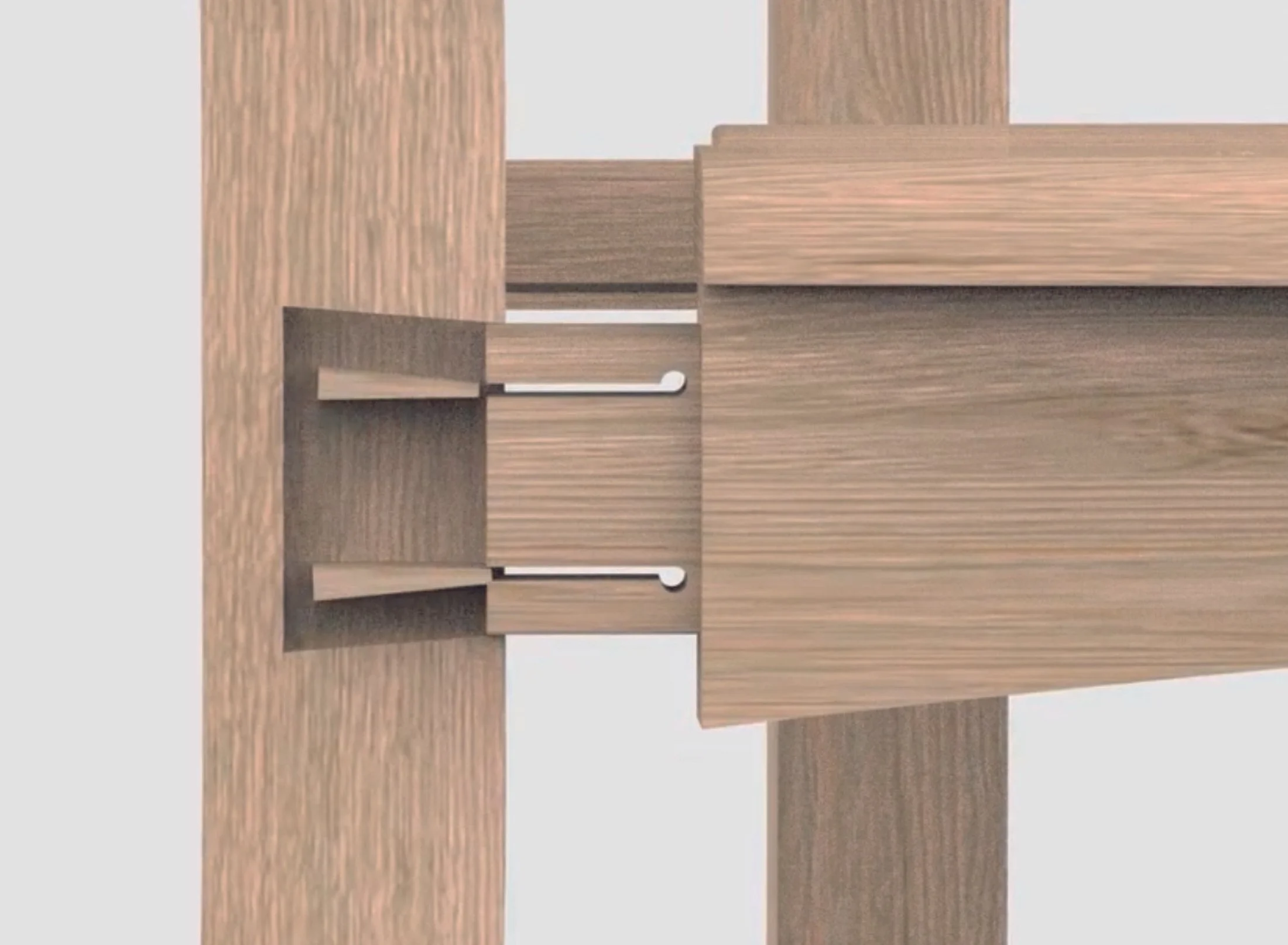
Enclosed fox wedged tenon step 1
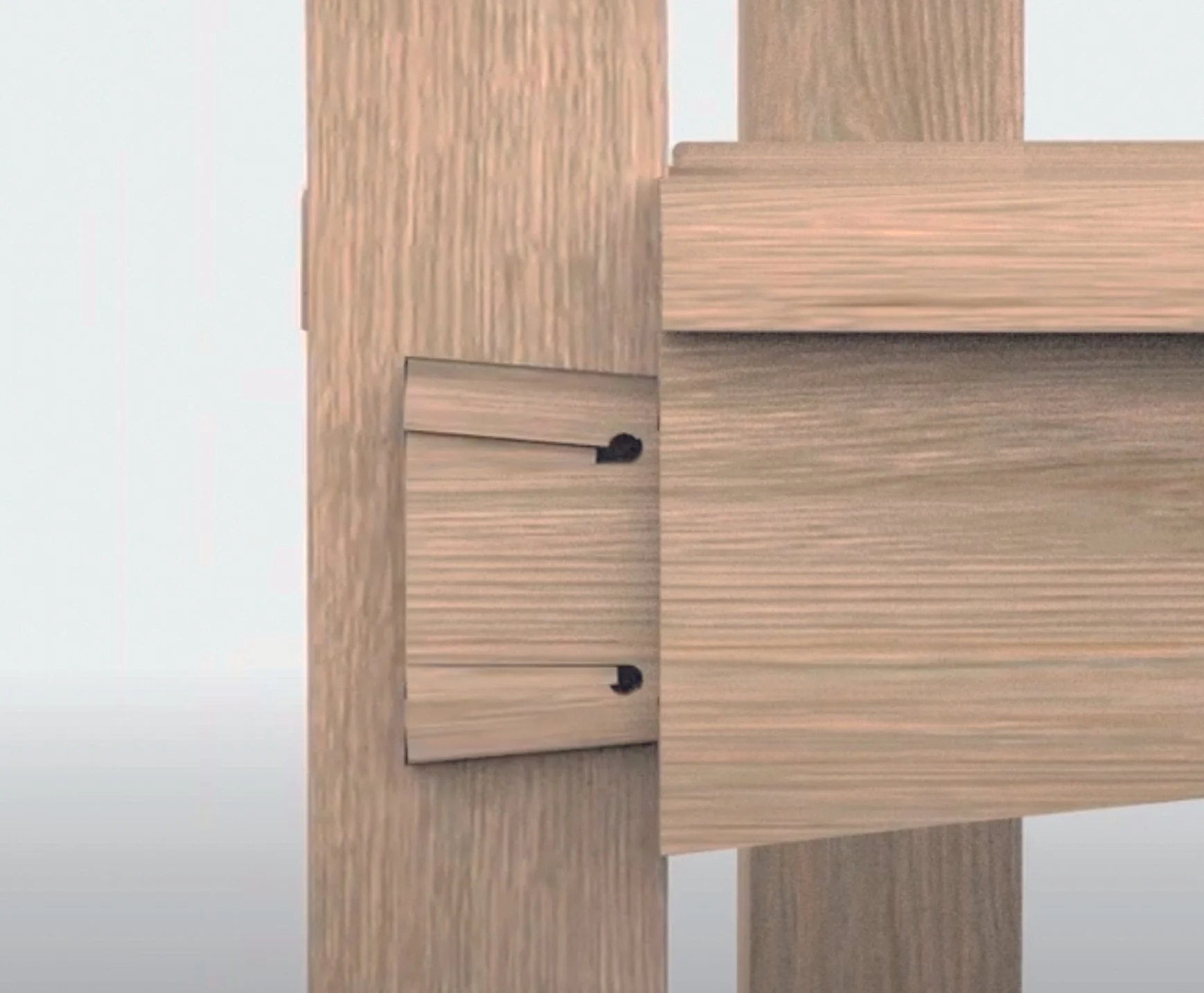
Enclosed fox wedged tenon step 2
For the seat slats we use only the centre or near centre-boards of a through-cut log, as this is the most stable cut, and this is very important for pieces which live outdoors. However, with a pipeline of specially cut ‘quarter sawn’ English oak laid down for future supplies, each with individual provenance, this will give us a better yield of the radial cut boards.
Once in our works the boards are marked out and band-sawn to the outlines of the components, a highly skilled operation to get the most out of this precious material. The parts are then planed smooth to give an airtight finish and placed on a 5-axis CNC, where vacuum suction is used to hold the work-piece down while a multitude of operations and tools are used to create a highly accurate component. These precision cutting operations include cutting both the dovetail mortise and saw-cut tenon for the fox wedged joints as well as pilot holes, positioning markers and delicate detailing to surround the point where the arm intersects with the back leg. Every seat is then assembled by one of our skilled craftsmen and finished by hand. Finally, each piece is serial numbered and initialled by the craftsman who put it together.
It is my belief that we didn’t lose our oak forests in the UK to shipbuilding. Rather, we stopped nurturing our oak forests in this country when the price of oak fell, due both to the end of wooden shipbuilding and to the increase of imported timber at prices which took no account of the environmental damage caused at their source. We should value provenance, and local hardwoods, highest.
What is exciting is that, as is so often the case, when challenged, we often come up with better solutions than if they just drop into our laps. This is the genius of the Amity Seat and we are working on more Grown in Britain hardwood designs to add to this.
Wood Culture: the Journal of Woodland Heritage is published annually as a benefit of membership. You can support Woodland Heritage by becoming a member - join below.