
By Matt Tutt
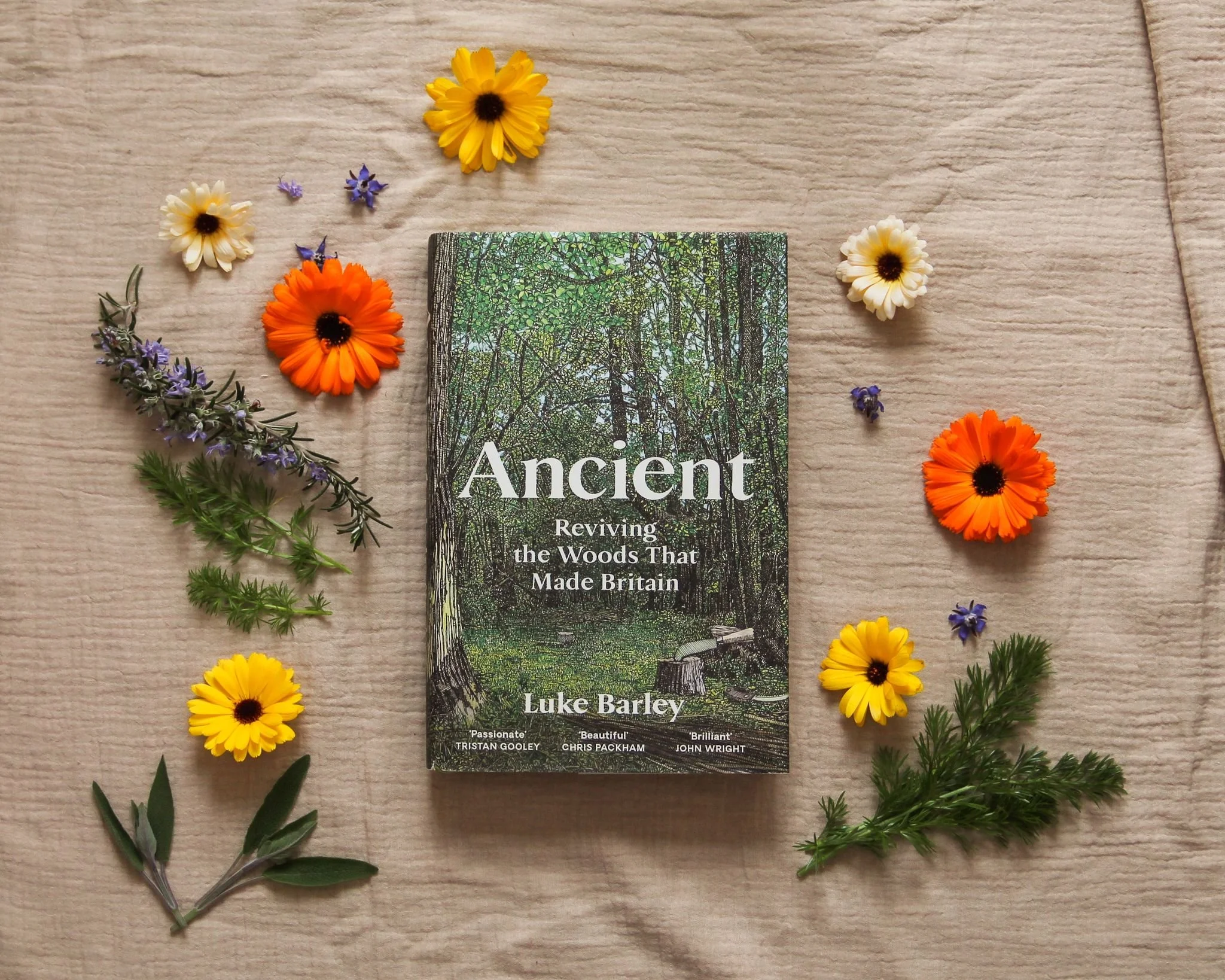
Before I even learned of Luke Barley’s new book Ancient: Reviving the Woods That Made Britain, I had been fairly involved in my own personal journey to understand more about green woodwork – the art of working wood whilst it is still freshly cut and rather than dried.
I think the main push towards this direction was when I picked up a second-hand copy of Mike Abbott’s brilliant book Living Wood – From buying a woodland to making a chair. This is the story of how Mike got involved with owning a woodland in Herefordshire with a group of like-minds.
I had been slightly transfixed by the idea of trying to imitate what Mike has been doing, as his passionate nature really came through from reading his story.
It wasn’t the first time I had had my head turned about this, sometimes romanticised, way of life: I also felt the same about Ben Law and all that he has done from his woodlands in West Sussex, having initially made a name for himself by appearing on Channel 4’s TV show Grand Designs.
I suppose you could say, I have been very much primed to read a book like Luke’s. I have always been interested in the environment and ecology, but perhaps a blind spot of mine here came from not really having a full knowledge of the history of Britain’s woodlands.
I think this is where Ancient really helps to complete the picture of why Britain’s woodlands have evolved in the way they have done, due to a predictably wide variety of factors as Luke carefully explains throughout the book.
What is Ancient about?
So, Luke Barley’s book isn’t just a historic account of Britain’s ancient woodlands: it touches upon his own life as an adviser to the National Trust, the economic influences that have shaped our woodlands, the way agriculture has left its mark, how war has played its part, what impact climate change is having, the political movements – such as ‘Enclosure’ – that have distanced humans from the land, and much more besides.
Luke speaks passionately about the positive impact that being amongst woodlands has had on his own mental health, and gives an interesting insight from his own perspective, which was often many feet high up within the crown of an ancient oak! (He is often involved in helping to prune these older oaks, to help maintain them).
It’s hard to talk about the history of our woodlands without having to look at economic and political factors, as Luke has done here. I think there’s a healthy balance between these topics and the more personable, ecologically-based ones.
It's probably fair to say as well that if you aren’t really interested in trees then you may struggle to get into a book like this… but I think (and will happily bet Luke will agree), if you have no interest in trees then you are very much missing out!
What I liked best about Ancient
I learned a lot from this book, particularly the chapters about ancient lime trees. I had a rough idea that one species of lime was often used for wood carving, at least for beginners, but it was fascinating to learn about their ability to ‘walk’ by the way old trees fall down and reshoot a few feet away.
I think my favourite thing about Luke’s work was that he wasn’t afraid to tackle difficult subjects fairly head on. Perhaps more space could have been dedicated to this, but perhaps that would make for quite a different type of book. For me there are issues with a lack of diversity in the woodland environments, and issues with “Nature Capitalism” whereby ecological benefits are crudely boiled down to their financial value.
I personally struggle with the idea that you can place a financial value on something like carbon sequestration of soils, or the benefit of a mycelial network that underpins the woodland floor. To equate some of these elements of a forest to a monetary value can be a slippery slope: do you then only do what has the highest financial value? How can you define the value in financial terms?
Of course, economics has had a massive impact on our woodlands and this is largely why much of our ancient woodland has been lost – cut down to plant non-native conifer plantations and so on. Luke argues that we need to find newer ways to value the woodlands that go beyond our current models, in order to encourage the plantation of more native species and to think in ‘tree years’, not our own timeline.
Perhaps one of my favourite passages of the book summarises my own feelings:
“The abuse of the natural world is a product of an exploitative economy combined with our resulting disconnection from the land; the dominant culture that ensued perpetuates our alienation from nature and allows the unsustainable use of natural resources to continue…
The most severe consequences of both economic injustice and nature disconnection continue to be felt by the most marginalised people, both in Britain and abroad.”
For me, having read around this topic for a while, the Enclosure period was a huge turning point. From people belonging to and living on the land, in an almost indigenous way, we were pushed off and so lost that connection. This distancing explains people’s ability to think of nature as an externality – something to be shaped and exploited by humans, to seek our own, often selfish, needs.
This brings me onto the idea of coppice working, which for me should be considered the pinnacle of whatever a ‘sustainable’ occupation might be. I love the paradoxical nature here: that cutting down trees can be the most beneficial thing for nature, with all the pollinators that thrive in such conditions. I think it’s hard for people to see and understand this until they’ve been to a hazel or chestnut woodland, and come to understand the positive impact that humans can have on the land.
In Summary - Thoughts on Ancient
This is clearly a work of passion and has been beautifully written by Luke, who was able to take a sabbatical from his role at the National Trust to pen this. I like how, within the Acknowledgements section at the end of the book, there were countless people wanted to thank. It reminds me of how woodlands function: they’re not just a series of different tree species, living their individualistic lives and doing their own thing. They’re a part of a big, constantly evolving and changing landscape, all closely connected and often working to support each other. I feel this is probably like writing a book, you can lean on various people to get support as you need it.
I sometimes wonder - it’s easy to get a person who likes trees to pick up a book like Ancient. But what can we do collectively to ensure there are always people who like trees? For me a big part of this is ensuring we have enough access to trees (especially ancient woodlands) as possible. And I think this is something we could be doing far more to achieve in the UK, and elsewhere too.
Editor’s note:
Thank you to Matt for contributing this review of Ancient: Reviving the Woods That Made Britain by Luke Barley.
To learn more about the benefits of productive woodland management you can read this page on our website: https://www.woodlandheritage.org/productive-woodlands
Woodland Heritage are working to ensure people have access not only to trees but to wood culture too. We’ve launched the Open Woods & Workshops initiative: A network of over 30 woodlands and workshops hosting open days across the UK throughout June 2026.
Find out more here: https://www.woodlandheritage.org/owaw
Luke Barley will be speaking at the Albion Timber Open Day on 27 June.
You can find out more about Ancient: Reviving the Woods That Made Britain here.
https://profilebooks.com/work/ancient/
If you would like to submit a book review to Woodland Heritage, please contact office@woodlandheritage.org